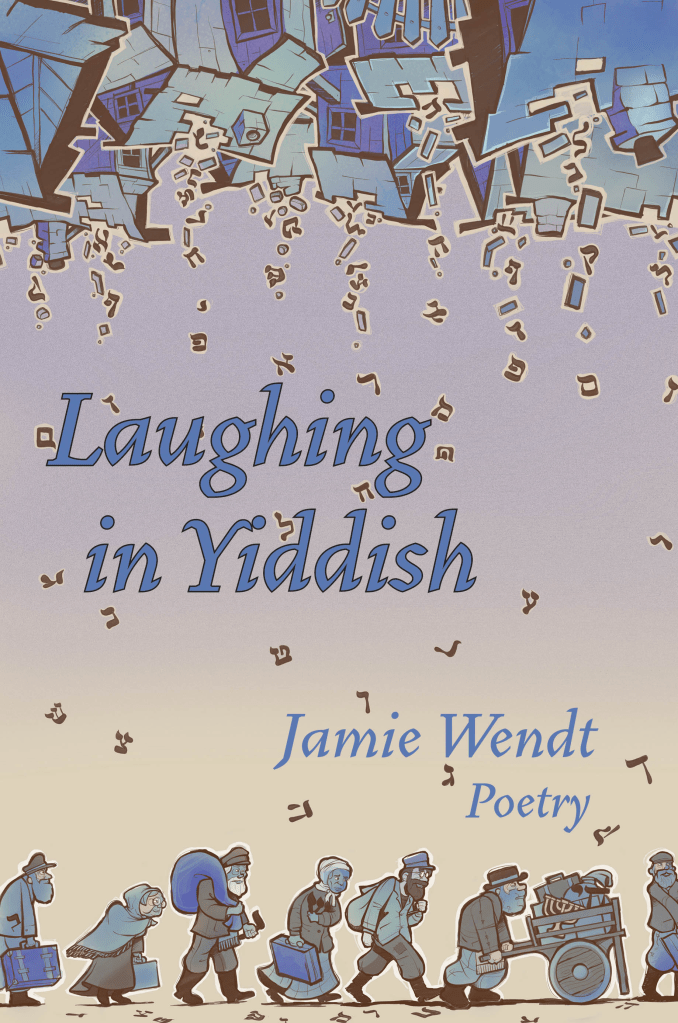
Laughing in Yiddish
Buy it from Broadstone Books or Amazon
Laughing in Yiddish is also available at the following locations:
Northbook Public Library in the Local Interest section
Secret World Books in Highland Park, IL
Bring Laughing in Yiddish to your Book Club or Classroom with A Reader’s Companion
Check out a live recording of Jamie Wendt reading from Laughing in Yiddish at St. Louis Poetry Center on October 28, 2025. A discussion between Jamie Wendt and poet Glendal Wallace follows the reading.
Praise for Laughing in Yiddish:
“In these deeply felt and painstakingly crafted poems, a woman grapples with centuries of Jewish persecution and diaspora. A visitation of ‘[w]inged angels – my ancestors’ opens the book, and it closes with a vow to keep telling the stories of ‘a wound bigger than the humid sky.’ The poems span geography and time, from Wendt’s ancestral roots in Russia to her family’s more recent life in Chicago, passing through pogroms and flight to ‘poverty and perseverance.’ Here you will find an insistence on history and an unflinching gaze on its horrors, held in equipoise with the blessings of family, faith, and tradition. Along the way you’ll hear stories told by Wendt’s grandfather and others, featuring everyday women and men struggling to survive, and more than a few golems. Throughout these poems, Yiddish words and phrases leaven writing that engages with formal tradition—pantoum, ghazal, triolet, ekphrasis—in order to ‘read and wrestle the past.’ Laughing in Yiddish is a comfort and a tikkun olam, offering a way to endure and remember, remember and endure.” —Rebecca Foust, author of ONLY and Marin County Poet Laureate emerita
“Jerusalem, Ancient Egypt, Lithuania, Chicago. Wendt’s striking poems conflate Jewish history, ancestral anecdotes, and contemporary experience. Laden with surprising and pleasurable leaps, Laughing in Yiddish movingly reminds us that the past haunts and enriches the present while the present preserves and sweetens the past. This is a luminous book!” —Yehoshua November, author of The Concealment of Endless Light
“Drawing on the history of the Jewish people, stories passed down from family to family, the work of Jewish artists (painters, photographers) and personal experience, Jamie Wendt has written a riveting and moving collection of poems. In persona, personal, and ekphrastic poems, Wendt creates a rich portrait of the Jewish people, both in their homelands of eastern Europe and in their displacement to the West, most specifically the city of Chicago. These beautifully crafted poems move from lyric to narrative to Whitmanesque revelations of the people—their work, their rearing of children, the rituals of their faith that hold their communities together, the horrors of war and persecution, their resilience. Wendt manages to deftly reveal the details of these lives and deaths, while at the same time opening our minds and hearts to the big picture. A rare and beautiful book, and just maybe, in these perilous times of rising antisemitism and autocracy, a necessary one.” —Jim Peterson, author of Towheaded Stone Thrower
“As a translator from Yiddish, I was thrilled to discover Jamie Wendt’s Laughing in Yiddish, a poignant collection of poems that beautifully bridges the vast expanse from the bustling streets of U.S. cities to the historic shtetls of the Pale of Settlement. Delving deep into Jewish history, weaving tales of joy and sorrow, Laughing in Yiddish juxtaposes lifestyles that are worlds apart, one where ‘In English, we learned words like tenement, factory, merchandise’ with one where ‘Jews were shot point-blank at Babi Yar.’ Wendt’s evocative verses make us reflect on the resilience and spirit of the Jewish people, particularly women, bearing witness to suffering and atrocities, yet retaining a constant spark of hope ‘in order to sing, to rise, to hallelujah.’” —Rose Waldman, Yiddish translator of Pioneers: The First Breach by S. An-Sky
“Wendt’s language is lyrical and visceral, an ongoing dialogue between past and present… Throughout the collection, we meet a cast of family members and historical figures whose stories are preserved through lyric and prose poems. Ekphrastic works further enrich the collection’s narrative depth, imagistically holding historical moments in time.” —Lizzy Itkin, from her book review of Laughing in Yiddish published in Tupelo Quarterly
“Laughing in Yiddish… brings an entire world of immigrant history vividly to life. Wendt uses sure-footed lyricism and deeply evocative imagery to tell the story of Jews living in a vibrant Russian shtetl, enduring pogroms and massacres and finally escaping to a new life in Chicago. She gives us, generously, the very real stories of street peddlers, grandparents, and great-grandparents, the sounds of early Chicago, the urban renewal that remade Chicago, and through it all the people finding strength through tradition and memory to make a new life after loss. Wendt uses a variety of formal and informal poetic forms to carry contemporary and historical voices, threading together the present and its past. The poems take risks, using ekphrastic poems, ghazals, pantoums, an ode, and even a triolet to build a nuanced and compelling history. They navigate that history from women working in a cigarette factory or at a spinning wheel, to the pogroms and massacres that the poet’s own ancestors survived in Lithuania, to a contemporary mother interrogating the past in order to build a world for her children.” —Rebecca Ellis, from her book review of Laughing in Yiddish published in Sugar House Review
“Jamie Wendt’s second collection of poetry, Laughing in Yiddish, maintains a delicate balance of earnestness and subtlety. The subtlety comes from attention to music and form: often pantoums, ghazals, and triolets, but an especially inventive deployment of those forms, including a ghazal mixed with interview, interview with bracketed commentary, and persona poems where the Eisenhower Expressway speaks, among other monologues dramatic, ekphrastic, and ethnographic. The earnestness comes from scope and content: rooted in family and community history, in the Midwest and Eastern Europe. Wendt is speaking for many when she writes, as in a kind of mission statement, ’They were not supposed to talk about it./No one did.//So, I fill in the blanks –’ and in the last poem, ’I will record your voice here.’” —Joshua Gottlieb-Miller, from his book review of Laughing in Yiddish published by the Jewish Book Council
“Laughing in Yiddish is a beautiful collection and is special because Wendt memorializes many pieces of history—from Kishinev to Chicago—that are in jeopardy of being lost. Her book is also a testament to resilience of immigrants and how hard they work to build a new a life for their families, all while shouldering the traumas they left behind.” —Susan Blumberg-Kason, from her book review of Laughing in Yiddish published in MER
“Jamie Wendt’s Laughing in Yiddish is a remarkable and moving collection that explores the intersections of identity, language, memory, location, and faith within the Jewish diaspora. Wendt’s mastery lies not only in the depth of emotion and cultural nuance but also in her deft manipulation of tone, weaving sorrow, joy, tenderness and strength throughout the four sections of the collection.” —Matthew Schnur, from his book review of Laughing in Yiddish published in Windy City Review
“A master of many forms, Wendt includes pantoums, ghazals, a triolet, a prose poem, and many ekphrastic poems. ‘Colossal Music,’ for example, is based on a Chagall painting of a fiddler… Persona poems predominate. The Eisenhower Expressway speaks in two poems. It’s hard to pick a favorite in this fine collection, but I have read and reread ‘The Eisenhower Expressway Speaks, 1951.’ While both poems deal with the destruction of neighborhoods and the upheaval created by the building of the expressway, there is also a touch of whimsy. The construction site becomes a playground for boys in ‘After summer storms / I turn into a brown river.’ (48) But as always there is darkness which here becomes macabre. After the removal of a cemetery, another rain leaves bones for the boys to gather like dogs in a game of fetch.” —Lois Baer Barr, from her book review of Laughing in Yiddish published in Highland Park Poetry
Thank you to Mom Egg Review (MER) for featuring Laughing in Yiddish in their March 2025 Bookshelf of suggested new reads!

Fruit of the Earth
Buy it from Main Street Rag Publishing Company
Fruit of the Earth won First Place for the National Federation of Press Women 2019 Award for a Poetry Book.
Praise for Fruit of the Earth:
Jamie Wendt considers place and displacement from both a personal and cultural viewpoint. Indeed, it can be challenging to observe with an outsider’s acute eye when one has the thoughtful heart of an insider. But it’s just this ability that makes these poems of tradition, ritual, family and selfhood exceptional. Her descriptions delight, but I’m most impressed with her ability to distill images into statements that enlighten and so beautifully express the complexities of longing. –Teri Youmans Grimm, author of Dirt Eaters (University Press of Florida) and Becoming Lyla Dore (Red Hen Press)
In Fruit of the Earth, Jamie Wendt brings us to “each side of the invisible border” between the Old Country and the Promised Land. She receives both the jewels and atrocities of her rich Jewish heritage and tries to change the direction of the future while praying in the Women’s Section at The Wall and helping deprived Sudanese refugee children in Tel-Aviv. These are exquisite poems of lament and of praise, “the laughter loud despite everything.” –Dina Elenbogen, author of the memoir Drawn from Water (BKMKPress, University of Missouri) and the poetry collection Apples of the Earth (Spuyten Duyvil, NY)
I love Jamie Wendt’s remarkable debut collection Fruit of the Earth. Her book is magnificent, lyric, intelligent: It is an ode and praise and elegy to the things of this world and the heart of the spiritual world. Her work is masterful, subtle yet complex, full of love and life. Read this book now! –Elizabeth A. I. Powell, author of the poetry collections The Republic of Self (New Issues) and Willy Loman’s Reckless Daughter (Anhinga Press)
In Fruit of the Earth, Wendt constantly looks around to ask, Where am I? Who am I? How can I make these two things, together, matter? Through answering these questions, she creates a lush, rich world where one’s place and identity are allowed to shift and realign themselves while still remaining true and real. –Elizabeth Deanna Morris Lakes in her JBC Book Review
In this powerful and exquisite collection of poems, Jamie Wendt … locates the interplay between the material and spiritual inheritance of land and people through themes of place, and displacement. In poems of vivid imagery and a strong, narrative voice, her experiences and questions are lived out while allowing that there is mystery that can only be accessed by the act of choosing, and choosing again, over a lifetime. Central to all is what it means to be a people uprooted and displaced through time while having a communal and religious identity as the locus of permanence even when the search for home—for security, freedom and peace–is an ongoing struggle. –Michelle Everett Wilbert in her Mom Egg Review Book Review
Despite numerous tangible references to place, time, and milestones throughout the collection, the author compliments these anchors with her vivid figurative work. Wendt’s lyrical use of language and keen observation of the things around her makes for imagery that activates each of the senses and enhances their play upon each other. In the reading of each poem, the mind displays a rich palette of images, and the reader develops a capacity to narrate these as a story. There is a harmonious centrality to each poem, where the acute sense of place or time gives way to simplicity of feeling. With her mastery over the temporal, Wendt crafts moments of refuge and suspension in her deeply nostalgic descriptions of memory. –Sarah Plummer in her Literary Mama Book Review
Watch: Interview with Highland Park Poetry (2019)

Feminine Rising: Voices of Power and Invisibility
Anthology of Women Writers edited by Andrea Fekete & Lara Lillibridge
Cynren Press (April 2019)
To purchase, please click HERE.
Check out a contributor promo video featuring Jamie Wendt!
Watch a virtual poetry reading with Jamie Wendt and other contributors from Feminine Rising.
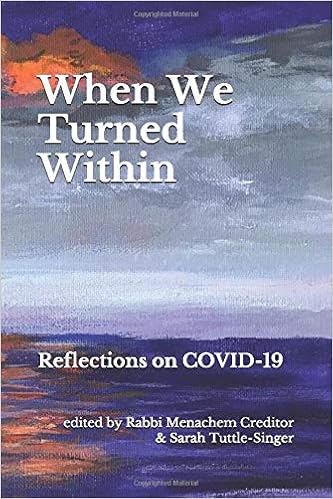 When We Turned Within: Reflections on COVID-19
Anthology of Jewish writers and rabbis
edited by Rabbi Menachem Creditor and Sarah Tuttle-Singer
(Independently Published; June 2020)
To purchase, please click HERE.
Jamie Wendt is a contributing poet.
 Jamie Wendt